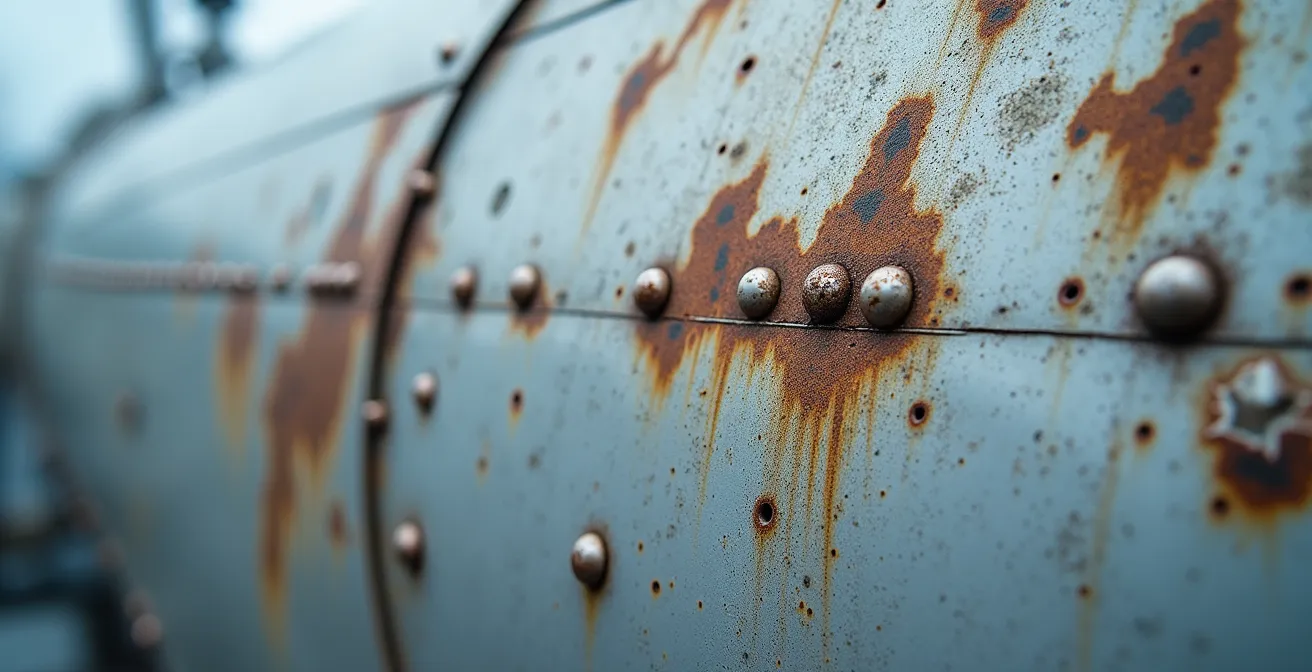
Most modelers approach weathering as a checklist of techniques, often resulting in an unrealistic, toy-like finish. This guide argues that authentic naval weathering isn’t about applying effects, but about telling a coherent environmental story. By understanding the science of corrosion, UV degradation, and fluid dynamics, you can transform your model from a simple replica into a miniature portrait of an aircraft’s harsh life at sea.
For many builders, the final hurdle is the most daunting. You’ve spent weeks, even months, assembling a perfect replica of a carrier-based aircraft. The construction is flawless, the paint job immaculate. Yet, it sits on the shelf looking sterile, lifeless—more like a high-end toy than a machine that has battled the elements. The common advice is to “add weathering”: apply a salt-fading effect, throw on some oil streaks, and darken the panel lines. But this often leads to a chaotic collection of effects, an artistic jumble that lacks a core truth.
The secret to transcending the toy-like appearance isn’t found in a bottle of wash or a new pigment set. It lies in a shift in philosophy. Instead of asking “what techniques should I use?” the master modeler asks “what story does this aircraft tell?” A machine operating in the intense sun of the Pacific will have a different story from one in the North Atlantic. Its exposure to saltwater, humidity, and constant ultraviolet radiation creates a unique biography etched onto its skin. This is not just about making a model look “dirty”; it’s about environmental storytelling, translating the physics of a maritime environment onto a miniature scale.
This guide moves beyond a simple list of tips. We will deconstruct the key environmental forces that act on naval aircraft and provide a framework for replicating them with narrative logic. We will explore the science of sun fading and salt spray, understand why aluminum corrodes differently from steel, and learn to avoid the common traps of over-weathering. By the end, you will have the tools not just to weather your model, but to give it a soul.
To navigate this complex but rewarding subject, this article is structured to walk you through the art and science of maritime exposure. The following sections break down each critical element, from the sun’s bleaching effect to the subtle signs of fluid maintenance.
Contents: The Art and Science of Naval Aircraft Weathering
- Sun fading: how to lighten the upper surfaces to simulate UV exposure at sea?
- White glazing: how to spray a subtle white mist to simulate dried salt spray?
- Why aluminum planes don’t rust (and what corrodes instead)?
- The “Spanish School” trap: when does artistic weathering become unrealistic?
- Non-slip surfaces: how to show wear on the rough wing walkways?
- How to Create Wet Fluid Leaks That Look Fresh on a Matte Model?
- Why Die-Cast Metal Models Are Outperforming Plastic in Investment Portfolios?
- Why Clean Models Look like Toys: Adding Authentic Weathering to Scale Aircraft?
Sun fading: how to lighten the upper surfaces to simulate UV exposure at sea?
Of all the forces battering a naval aircraft, the sun is perhaps the most relentless. Constant exposure to ultraviolet (UV) radiation bleaches and breaks down paint, but this effect is far from uniform. The operational theater dictates the intensity of this process. For instance, naval aircraft in the Pacific theater often show more pronounced UV damage than their Atlantic counterparts due to consistently higher sun angles and greater intensity. This environmental context is the first chapter of your model’s story. The goal isn’t just to lighten the paint; it’s to replicate the specific, chalky, and uneven bleaching caused by years under a harsh maritime sun.
Achieving this requires a multi-layered approach that moves beyond simply mixing white into the base color. True-to-life fading is a patchwork of subtle variations. Horizontal surfaces like the top of the fuselage and wings bear the brunt of the exposure, while vertical surfaces remain comparatively untouched. The process involves creating layers of translucency, where the original color is subtly visible beneath a damaged, faded topcoat. This differential fading tells a story of exposure and time, making the effect believable.
The key is to build the effect in thin, almost imperceptible layers. Using heavily thinned paint allows for a gradual build-up, creating a more organic and less stark transition. Techniques like “dot filtering” with oils and misting on specific tones like Tamiya Deck Tan can break up the uniformity, simulating the random nature of sun damage. The final touch is often a specific varnish that can replicate the slightly chalky texture of paint that has had its chemical binders broken down by UV light.
Action Plan: Realistic UV Fading on Naval Aircraft
- Initial Dot Filter: Apply small dots of oil paints (burnt umber, raw umber, yellow ochre, white) to the surface. For Navy aircraft, incorporate lighter blues to begin the simulation of UV bleaching before blending with a thinner-moistened brush.
- Create the Fade Coat: Mix the model’s base color with 10-15% white for upper surfaces. Thin this mixture heavily, aiming for a 90/10 ratio of thinner to paint, to create a translucent, subtle patchwork effect when airbrushed.
- Simulate Uneven Exposure: Apply Tamiya Deck Tan in random, fine ‘scribble’ patterns across the upper surfaces. This breaks up the monotone fade and simulates areas of more intense, uneven sun exposure.
- Differential Fading: To create a realistic contrast, mist the decals separately with the lightened base color. This shows that the decals and the paint fade at different rates, adding a layer of historical accuracy.
- Seal with Texture: Seal the final effect with a matte varnish that has been mixed with a very small amount of pearl powder. This replicates the characteristic chalky, slightly reflective texture of UV-damaged paint.
White glazing: how to spray a subtle white mist to simulate dried salt spray?
Salt is the ever-present ghost of naval aviation. It’s carried by the wind, kicked up by carrier operations, and baked onto every surface by the sun. Simulating this isn’t about caking the model in salt crystals; it’s about understanding how salt behaves. When seawater evaporates, it leaves behind a fine, whitish-grey crystalline residue. This residue accumulates based on aerodynamic flow and gravity. It’s heaviest behind protrusions like antennas or panel lines that disrupt airflow, and it forms streaky runs down vertical surfaces after rain or wash-downs. Replicating this requires thinking like the wind and water.
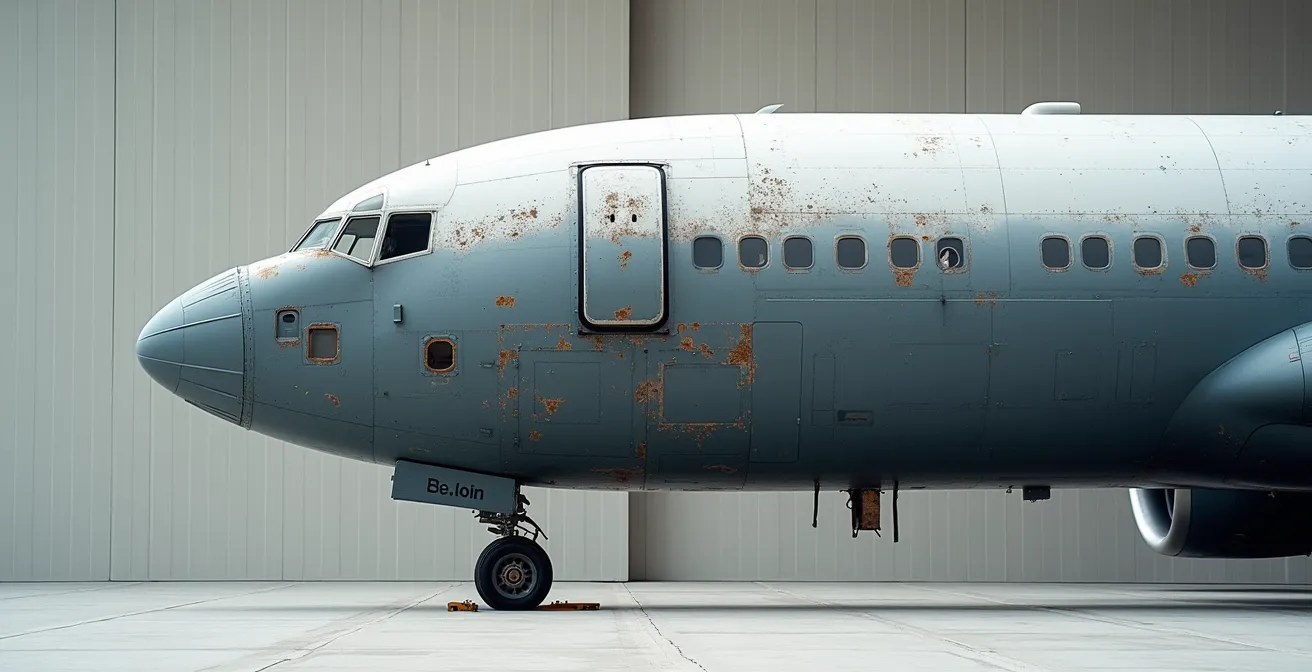
As the image demonstrates, salt accumulation is not random. It follows logical paths dictated by the aircraft’s shape and its movement through the air. The most realistic effects are achieved by layering different types of salt deposits. A general, very thin “glaze” of off-white across the entire aircraft can represent the fine, ever-present salt mist. More concentrated deposits can then be built up in specific areas like wing roots, landing gear bays, and panel lines where saltwater would naturally pool and evaporate, leaving a thicker crust.
This table outlines different methods for achieving specific salt effects, allowing you to tailor the weathering to the narrative of each part of the aircraft. For example, the fine mist on a leading edge tells a different story from the thick crusts in a gear bay.
| Aircraft Area | Salt Application Method | Visual Effect | Products/Mix |
|---|---|---|---|
| Leading Edges | Fine misting with airbrush | Dusty, fine salt film | White + grey 70/30, thinned 90% |
| Wing Roots/Gear Bays | Stippling with sponge | Thick crystalline crusts | White paint + microballoons |
| Panel Lines | Capillary action with brush | Concentrated deposits | Thinned white wash |
| Control Surfaces | Dry brushing | Streaky salt runs | White chalk powder |
Why aluminum planes don’t rust (and what corrodes instead)?
One of the most common mistakes in weathering aircraft is applying iron oxide—or rust—effects. Aircraft, especially naval ones, are primarily constructed from aluminum alloys for their strength-to-weight ratio. Aluminum does not rust; rust is specifically the oxidation of iron or its alloys. However, this does not mean aluminum is immune to the harsh maritime environment. In fact, corrosion is a relentless and costly enemy of naval aviation. The science of aluminum corrosion is simply different, and understanding it is crucial for realistic weathering. In the real world, corrosion costs military aviation an immense amount, with one report indicating the U.S. Army’s Aviation and Missile Command spends $1.6 billion each year to address corrosion on its helicopters.
Instead of the reddish-brown flaking of rust, aluminum alloys are susceptible to several other forms of degradation. The most common in salty environments is pitting corrosion. This is a localized form of corrosion that leads to the creation of small holes, or “pits,” in the metal. As described by materials engineers, pitting corrosion manifests itself as tiny pinholes when the powdery white or grey aluminum oxide deposit is cleaned away. On a model, this can be simulated with fine, dark pin-washes in specific areas, representing the small cavities filled with grime.
Other insidious forms include exfoliation and intergranular corrosion. Exfoliation is where the corrosion products build up along the grain boundaries of the metal, causing the surface to lift and peel back in layers, almost like the pages of a book. This is often seen on the edges of wing skins and other load-bearing structures. Intergranular corrosion is an attack along the grain boundaries that may not be visible on the surface but can severely weaken the structure. For a modeler, replicating exfoliation involves creating subtle raised and chipped paint effects along the edges of panels, showing the metal surface seemingly delaminating from beneath.
The “Spanish School” trap: when does artistic weathering become unrealistic?
In the world of modeling, there is a style of weathering, often dubbed the “Spanish School,” known for its high-contrast, artistic, and visually dramatic effects. While it has produced breathtaking models, it can also be a trap for those seeking realism, especially in naval aviation. The trap is this: focusing on applying every known technique—heavy chipping, stark panel line washes, dramatic rust streaks (often incorrectly), and intense color modulation—without a guiding narrative. The result is a model that looks less like a machine subjected to a specific environment and more like a canvas for demonstrating technical skill. The weathering becomes the subject, rather than the aircraft itself.
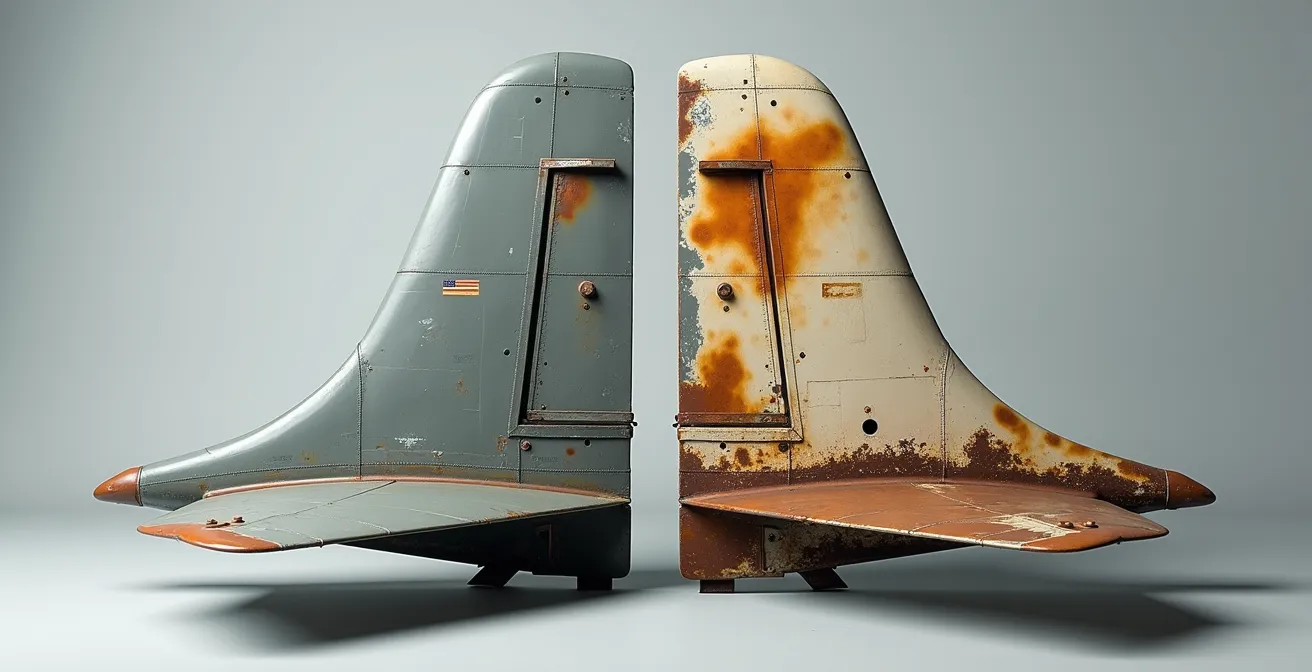
Realistic weathering is about restraint and logic. Every effect must have a cause. Why is that panel more chipped than the one next to it? Is it a high-maintenance access panel? Why is that streak running from that particular point? Is it a hydraulic fluid overflow line? As one professional modeler notes when discussing jets, the goal is not to overwhelm the eye.
The panel lines and access doors are places where two or more pieces of aluminum typically come together, so the gaps tend to fill with deep, dark black dirt and aluminum rubbings. My goal is to duplicate that color and only highlight the surface details to attract the eye—not overwhelm.
– Professional scale modeler, Model Aviation Magazine
To avoid this trap, every weathering decision should be filtered through a logical framework. Before applying an effect, ask yourself a series of questions to ensure it fits the story you’re telling. This framework transforms the process from random application to deliberate storytelling.
Checklist: Narrative Logic for Realistic Weathering
- Operational History: What specific operational history am I depicting with this model? Is it early in its deployment, mid-tour with significant wear, or at the end of its service life?
- Logical Cause: Does each weathering effect I apply have a logical, real-world cause? Can I trace this salt streak to sea spray, or this oil stain to a specific leak point?
- Scale Consistency: Is the intensity of the weathering consistent with the model’s scale? A 1/72 scale aircraft requires much subtler effects than a large 1/32 scale model to be believable.
- Logical Concentration: Are the effects concentrated in logical areas? Focus on high-wear zones (walkways, canopy sills), fluid leak paths, and surfaces with maximum UV and salt exposure.
- Coherent Story: Does the overall effect tell a single, coherent story, or does it look like a sampler of every possible weathering technique? Does it read as a unified whole?
Non-slip surfaces: how to show wear on the rough wing walkways?
Among the most distinctive features of a carrier aircraft are the dark, rough patches on the wings and fuselage. These are the non-slip walkways, critical for the safety of pilots and maintenance crews working on a potentially wet and pitching flight deck. On the full-size aircraft, these areas are coated with a thick, textured material much like rough sandpaper. This surface is not immune to wear. In fact, its degradation is a key part of the aircraft’s visual story. The constant scuffing of boots, the dragging of equipment, and the general abuse of a working environment cause this coating to chip, peel, and wear away, revealing the lighter camouflage paint underneath.
Replicating this texture and wear is a multi-step process. First, the texture itself must be created. A common and effective method is to mix a substance like microballoons or very fine sand directly into the dark grey or black paint used for the walkway. This mixture is then carefully applied to the masked-off walkway areas. The key to realism, however, lies in simulating the wear *before* applying the textured coat. As described in a useful walkthrough of weathering tricks, one can tear small, irregular bits of masking tape and place them randomly within the walkway area before painting. After the textured paint is applied and dried, removing these small tape pieces reveals clean, sharp “chips” of the underlying camouflage color.
The storytelling doesn’t stop there. Once the primary chipping is established, a second layer of weathering can be added to show use over time. High-traffic areas, like the paths the pilot takes to the cockpit, can be lightly sanded to thin the textured coating, suggesting more gradual wear. Finally, pigments representing ground-in dirt and grime can be worked into the rough texture, concentrating them along the edges of the wear paths. This layering of effects—chipping, wear, and dirt—creates a deeply convincing representation of a surface that has seen hard and constant use.
How to Create Wet Fluid Leaks That Look Fresh on a Matte Model?
A pristine aircraft is a fantasy. Real-world machines, especially high-performance military jets, are a complex network of hydraulic lines, fuel systems, and oil reservoirs. They leak. These leaks are an essential part of an aircraft’s visual identity, telling a story of maintenance, use, and mechanical stress. The ultimate challenge for a modeler is to create fluid effects that look fresh and wet, providing a stark contrast to the otherwise matte and weathered finish of the model. This contrast between wet and dry is what truly sells the effect.
A key advanced technique is to represent the passage of time. Not all leaks are fresh. Old stains from past leaks or flushed-out contaminants will be matte and absorbed into the paint. Fresh leaks are glossy and appear to sit on the surface. By first creating faint, matte stains using thinned oils or enamel washes, you establish an operational history. Then, over these old stains, you can apply the “fresh” leak. This layering creates an incredible sense of depth and realism. The fresh leak is typically made from a mix of oil paints (for color) and a clear gloss medium, which gives it the permanent wet look.
The appearance of the leak depends entirely on the type of fluid being simulated. Each has a distinct color, consistency, and finish. Getting these details right is critical for a believable effect. This table breaks down the visual characteristics of the most common fluid types found on naval aircraft.
| Fluid Type | Color Mix | Consistency | Gloss Level | Application Method |
|---|---|---|---|---|
| Hydraulic Fluid | Purple-red tint | Thin, runny | High gloss | Thin wash with drops |
| Engine Oil | Burnt umber + black | Thick, viscous | Semi-gloss | Controlled streaks |
| Fuel | Clear with rainbow sheen | Very thin | Wet look | Gloss varnish + pearl |
| Coolant | Blue-green tint | Medium | Satin | Airbrush misting |
Key Takeaways
- Weathering is environmental storytelling; every effect must be driven by a logical, real-world cause related to the aircraft’s operational history.
- Aluminum aircraft do not rust. They suffer from distinct forms of corrosion like pitting and exfoliation, which create white/grey deposits and peeling surfaces.
- Avoid the “over-weathering” trap by using a narrative logic framework. Realism comes from restraint and coherence, not from applying every possible technique.
Why Die-Cast Metal Models Are Outperforming Plastic in Investment Portfolios?
In the world of collecting, a peculiar discussion sometimes arises, framed around the financial value of die-cast versus plastic models. Die-cast models, with their heft and pre-finished state, are often seen as durable collectibles. But this perspective misses the fundamental point of scale modeling as an art form. As one publication aptly puts it, the goal is something more visceral.
Squeaky-clean has its merits, but the model that’s sure to generate attention and comment is the one that looks like it might smell of hot glycol or burnt kerosene.
– FineScale Modeler Magazine
This quote cuts to the heart of the matter. The true “investment” in a plastic scale model is not in its base material, but in the artistry and skill invested by the builder. While a die-cast model has a fixed, manufactured value, a plastic kit is a blank canvas. Its ultimate worth is derived from the builder’s ability to transform it from inert plastic into a convincing, miniature reality. A museum-quality build, with its layers of painstakingly applied weathering, tells a story that no mass-produced die-cast can match.
The value here is one of narrative craftsmanship. When a modeler realistically replicates the scorched metal from engine exhaust, the chipped paint on high-traffic panels, and the subtle saline corrosion from a life at sea, they are creating a unique piece of art. This level of detail and storytelling is where the real value lies. An expertly weathered F/A-18 plastic model commands a premium not because it is made of plastic, but because it captures a moment in time, a biography of service that speaks to the viewer. In this context, the “investment” is in the hours of research, the patient application of technique, and the creation of a coherent narrative—an investment of soul, not just material.
Why Clean Models Look like Toys: Adding Authentic Weathering to Scale Aircraft?
At its core, the drive to weather a scale model stems from a single, universal truth: reality is imperfect. A brand-new aircraft rolling off the assembly line is the only time it will ever be perfectly clean. From its first flight, its story begins to be written on its skin by the sun, the sea, and the hands of its crew. A model that lacks this story feels sterile and disconnected from the very reality it seeks to represent. As Scale Modelling Now magazine states, the goal is to create “less like a replica toy and more of a scale representation of the original subject which incorporates artistic features to make it visually compelling.”
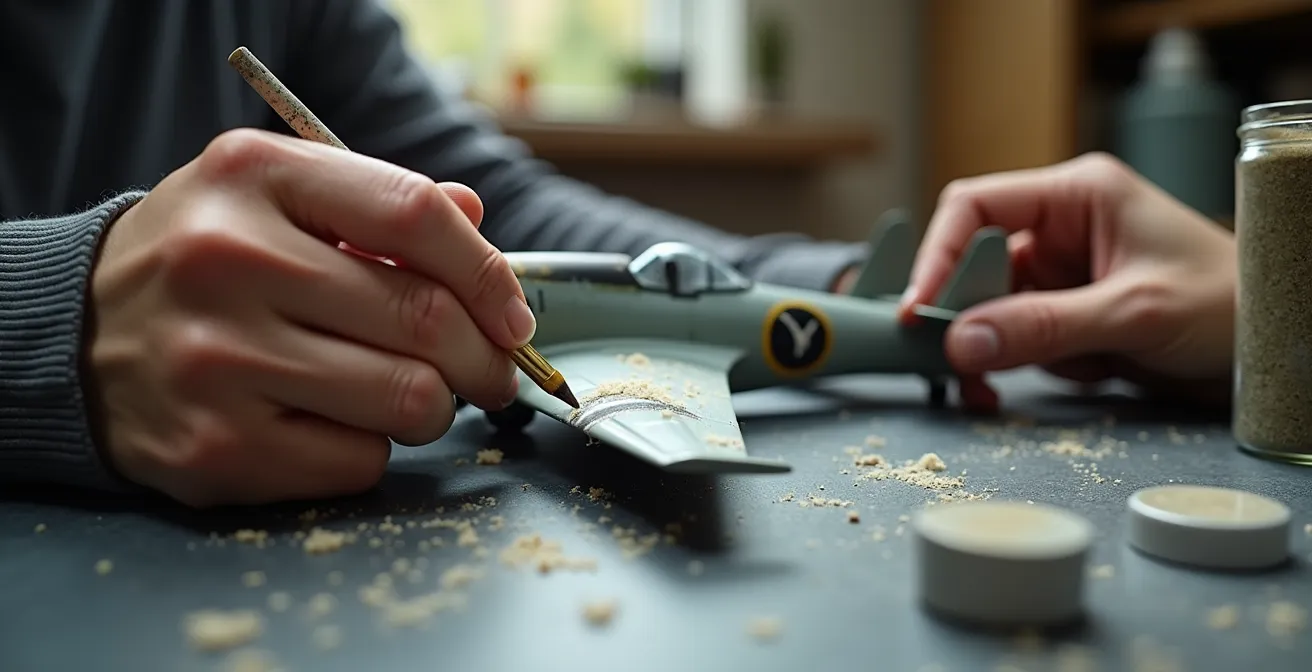
Authentic weathering is the bridge between replica and representation. It is the conscious and deliberate process of adding the effects of time, physics, and environment to tell a believable story. This is not a matter of mere aesthetics; it is grounded in harsh operational facts. Corrosion, for example, is a constant battle in naval aviation, with real-world consequences. It is not just a visual detail; it has significant operational impact, as one analysis noted that for the US Navy and Marine Corps, the average number of days per aircraft unavailable due to corrosion-related maintenance was 26.5.
By embracing the philosophy of environmental storytelling, a modeler elevates their work. Each faded panel, each salt streak, and each fluid leak becomes a sentence in the aircraft’s biography. The final model is no longer a simple collection of plastic parts painted in the right colors. It is a snapshot of history, a three-dimensional narrative that captures the unforgiving beauty of a machine’s life at sea. This is the ultimate goal: to build something that feels not just seen, but experienced.
Stop building replicas. Start telling stories. Apply this environmental narrative to your next carrier-based aircraft and watch it transform from a plastic toy into a testament to the unforgiving beauty of the sea.