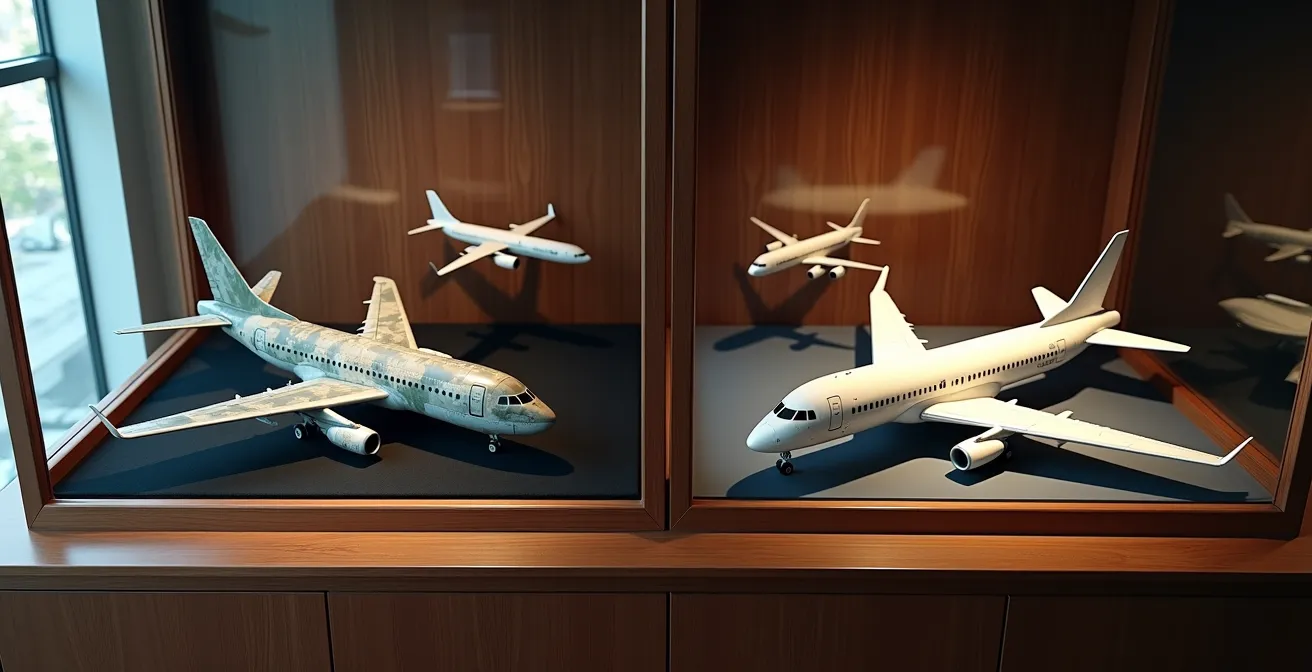
The long-term value of a model aircraft collection is determined less by the subject (military vs. civil) and more by a disciplined strategy of curating verifiable scarcity and technical fidelity.
- Limited-run military prototypes often have a built-in scarcity premium, while iconic airliners depend on flawless execution and livery accuracy.
- Documented provenance and thematic coherence, such as maintaining a consistent scale and era, can significantly increase a collection’s auction value.
Recommendation: Treat your collection as a curated portfolio, prioritizing models with documented history and protecting them as you would any other valuable asset.
For the discerning collector, a model aircraft is more than a decorative object; it is a tangible asset, a piece of history frozen in miniature. The central question for those who view their collection through the lens of investment is a persistent one: where does long-term value truly lie? Many collectors are drawn either to the aggressive lines of military aircraft or the elegant liveries of civilian airliners. The conventional wisdom often suggests simply “collecting what you love.”
This advice, while emotionally sound, is insufficient for building a portfolio with appreciable value. The market for high-quality models is sophisticated, with a projected growth rate that commands serious attention. The global model aircraft market is expected to expand with a 5.30% CAGR from 2024 to 2031, indicating a robust and growing interest. This transforms the hobby from a simple pastime into a potential alternative asset class.
But if the key isn’t merely the subject, what is it? The truth is that a high-value collection is not an accident of passion. It is the result of a curatorial strategy that prioritizes verifiable scarcity, technical fidelity, and documented provenance. It requires treating each acquisition not as a purchase, but as an investment decision. This guide will deconstruct the factors that drive value, moving beyond the military versus civilian debate to provide a framework for building a collection that is both aesthetically pleasing and financially sound.
This article provides a structured analysis for the serious collector. We will dissect the key value drivers, from the economics of scarcity in military prototypes to the critical importance of finish and historical accuracy, providing a clear roadmap for curating a collection that stands the test of time.
Summary: Military vs Civil Aircraft Models: Which Collection Retains Value Better?
- Why do limited run military prototypes fetch higher prices at auction?
- How to achieve the perfect gloss finish required for civilian airliners?
- Camouflage or Commercial Livery: which offers more creative painting challenges?
- The error of mixing eras that ruins a serious model collection
- How to store wide-span bombers vs long-body airliners safely?
- Why Die-Cast Metal Models Are Outperforming Plastic in Investment Portfolios?
- How to Choose an Acrylic Case That Protects Your Models from UV Yellowing?
- What Defines a High-Fidelity Replica for Serious Aviation Collectors?
Why do limited run military prototypes fetch higher prices at auction?
The core principle driving the high valuation of military prototypes is not aesthetics, but fundamental economics: verifiable scarcity. Unlike commercial airliners, which are produced in large numbers with numerous livery variations, military prototypes and experimental aircraft often exist as one-off or extremely limited-run subjects. This inherent rarity creates a significant scarcity premium in the secondary market. Collectors are not just acquiring a model; they are acquiring a representation of a unique moment in aviation history that few others can own.
For example, a standard, mass-produced model of a Boeing 737 may struggle to retain its initial retail price. In contrast, a meticulously crafted model of a North American XB-70 Valkyrie or a YF-23 Black Widow II taps into a market where demand far outstrips supply. These subjects represent technological ambition and “what if” scenarios that captivate aviation enthusiasts and historians alike. The narrative behind the aircraft—its secrecy, its advanced technology, or its failure to enter production—becomes part of its value proposition.
Market data confirms this trend. While it’s reported that 90% of standard models typically lose value, collectors have seen rare models appreciate significantly. A prime example is the AN-225 model, with only 10 pieces produced globally, which exemplifies how extreme scarcity drives premium valuations. The smaller the production run and the more historically significant the aircraft, the greater its potential as a tangible asset. The investment thesis is clear: seek out the unique, the experimental, and the historically pivotal. These are the pieces that transcend the hobbyist market and enter the realm of serious collectibles.
How to achieve the perfect gloss finish required for civilian airliners?
While military models often demand matte, weathered finishes to reflect their operational use, civilian airliners are judged by a different, arguably more demanding standard: a flawless, high-gloss finish. This “wet look” replicates the pristine condition of a commercial aircraft and is a hallmark of a high-quality build. Achieving this finish is a matter of meticulous process, where any shortcut will reveal itself in the final product. It is a pure test of technical execution.
The process goes far beyond simply spraying a gloss clear coat. It begins with a perfectly smooth surface, free of any texture or imperfections from the base colors. Professional modelers often buff the underlying matte paint with a soft cloth to create a glass-like foundation before the first gloss layer is even applied. Subsequent coats must be thin and even, with light sanding or polishing between layers to eliminate any dust particles or “orange peel” texture. This painstaking process is what separates a good model from a masterful one.
As one expert modeler on the Airliners.net forums noted, the choice of materials and equipment is paramount. His preferred method highlights the technical specificity required:
I prefer to use a laquer based clear coat shot at 20 PSI from a Badger 150 dual action airbrush, lacquer mixed approximately 60/40 lacquer to thinner. Future must be cleaned immediately with ammonia or it will ruin your airbrush.
– 1/144Modeler, Airliners.net Forum – Techniques for Glossy Finishes
This level of detail—specifying PSI, mixture ratios, and cleaning agents—underscores that a perfect gloss finish is not an artistic flourish but a technical discipline. For the investor-collector, a model with a perfect gloss finish is a direct indicator of the builder’s skill and commitment, and therefore, a key component of its retained value.
Camouflage or Commercial Livery: which offers more creative painting challenges?
The debate between military camouflage and commercial livery is not just aesthetic; it represents two fundamentally different schools of technical challenge and artistic interpretation. Neither is inherently “harder,” but they require distinct skill sets. For the collector, understanding these challenges is key to appreciating the craftsmanship that drives a model’s value. Camouflage is a challenge of blending and weathering, while commercial liveries are a test of precision and perfection.
Military camouflage, especially on aircraft, involves recreating complex patterns that were often applied by hand in the field. The key challenge lies in achieving soft-edged, feathered transitions between colors, a task that demands exceptional airbrush control. Furthermore, a military model is incomplete without weathering—the replication of exhaust stains, fluid leaks, paint chipping, and panel line fading. This process transforms the model from a static replica into a historical snapshot, telling the story of its operational life.
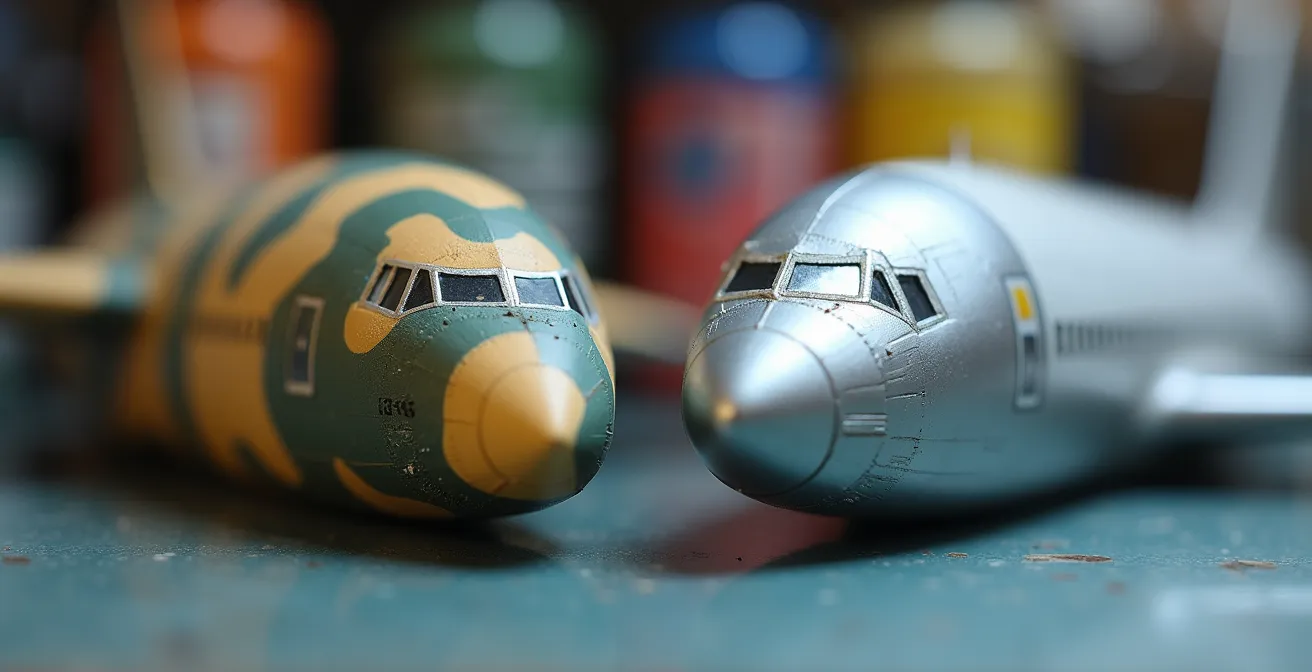
In stark contrast, commercial liveries demand absolute precision. The challenge here is creating crisp, hard-edged geometric lines, such as the “cheatlines” that run along the fuselage. This requires meticulous masking, often for days at a time. The paint must be a high-gloss, flawless finish with no room for error. Weathering is minimal and subtle, often limited to faint panel line definition. The goal is to represent a multi-million dollar corporate asset in its ideal state, not a war-weary machine.
This table breaks down the distinct technical demands:
| Aspect | Military Camouflage | Commercial Livery |
|---|---|---|
| Paint Type | Flat/Matte finish for scale realism | High gloss requiring 2-3 clear coats |
| Masking Complexity | Soft-edge, feathered transitions | Hard-edge, precise geometric lines |
| Color Accuracy | Historical research for specific units | Corporate color matching critical |
| Weathering | Heavy weathering expected | Minimal, subtle panel line work only |
| Decal Application | Stencils and tactical markings | Complex multi-part airline logos |
The error of mixing eras that ruins a serious model collection
One of the most common mistakes that undermines the value of a collection is a lack of focus. A display shelf featuring a World War I biplane next to a Cold War jet, which in turn is next to a modern airliner, may reflect eclectic taste, but it demonstrates a lack of curatorial discipline. From an investment perspective, this is a significant error. A serious collection tells a story, and that narrative is built on curation coherence. This coherence is most often defined by two critical factors: scale and era.
Maintaining a consistent scale is paramount. A collection composed entirely of 1/72 or 1/48 scale models allows for direct visual comparison of the aircraft, creating a powerful, museum-like presentation. It demonstrates intent and seriousness. Mixing scales (e.g., a large 1/32 scale fighter with a small 1/144 scale bomber) breaks this visual harmony and makes the collection appear haphazard and juvenile. The market recognizes this distinction; secondary market analysis shows that collections maintaining consistent 1/72 scale command 40% higher bulk sale prices than mixed-scale lots.
Equally important is thematic consistency, often centered on an era or a specific conflict. A collection focused on “Fighters of the Vietnam War,” “Early Jets of the Royal Air Force,” or “Airliners of the 1970s Golden Age” has a clear identity. This thematic core adds significant intellectual and financial value. It transforms a group of individual models into a unified, educational exhibit. A potential buyer is not just acquiring plastic and paint; they are acquiring a curated exploration of a specific chapter in aviation history. Without this coherence, a collection is simply an assortment of toys with little chance of significant value appreciation.
How to store wide-span bombers vs long-body airliners safely?
An asset is only valuable if it is properly preserved. For large-scale aircraft models, improper storage is the primary cause of irreversible damage and value destruction. Dust, UV light, humidity, and physical stress are constant threats. The unique geometries of different aircraft—the vast wingspan of a B-52 bomber versus the long, slender fuselage of a Boeing 777—require bespoke storage solutions for long-term risk mitigation.
Wide-span models, such as strategic bombers or reconnaissance aircraft, are particularly susceptible to “wing droop.” The constant, unmitigated force of gravity on long, heavy wings can cause them to sag over time, permanently ruining the model’s profile. The solution is custom support. A proper display case for a wide-span model must include custom-cut foam or acrylic cradles that support the wings at multiple points along their length, distributing the load and neutralizing gravitational stress.
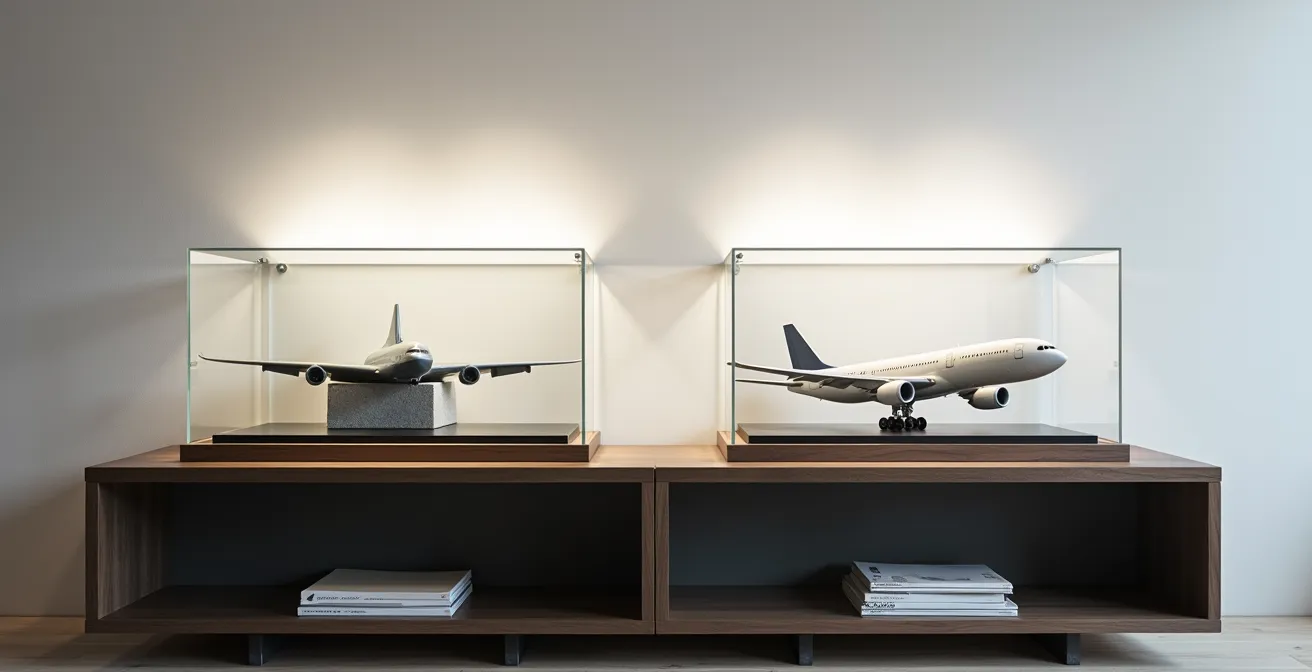
Long-body airliners present a different challenge: fuselage sag. A long, narrow tube supported only at its ends (e.g., by its landing gear) can begin to bow in the middle over years of display. The professional solution is a central fuselage support cradle. This is typically a discreet, custom-shaped support made of clear acrylic that sits beneath the model’s center of gravity, providing crucial reinforcement without detracting from the visual presentation. For any serious collector, investing in purpose-built cases with appropriate structural supports is not an expense; it is a necessary measure to protect the capital invested in each piece.
Why Die-Cast Metal Models Are Outperforming Plastic in Investment Portfolios?
For decades, the world of serious scale modeling was dominated by plastic kits, which required assembly and painting. However, in the investment-grade market, high-quality, pre-assembled die-cast metal models are increasingly outperforming their plastic counterparts. This shift is driven by factors of perceived value, material integrity, and a broader collector base. Die-cast models feel substantial and durable, giving them a psychological edge in perceived quality over the lightweight nature of plastic.
Market data points to this divergence in performance. For example, recent market analysis reveals metal die-cast models show a 6.8% CAGR in the burgeoning China market, more than double the 3.0% growth for plastic kits in the mature French market. This suggests that new and emerging collectors are gravitating towards the ready-to-display, high-fidelity nature of die-cast metal. These models often come from manufacturers like Gemini Jets or InFlight200, who focus exclusively on producing collector-grade, limited-edition pieces.
Premium Die-Cast Collection Value Analysis
An analysis of premium die-cast models shows that those featuring complex moving components, such as retractable landing gear, adjustable flaps, or opening canopies, consistently command prices two to three times higher than equivalent static plastic kits. Furthermore, models produced under official license from major airlines (like Emirates) or manufacturers (like Boeing) retain their value more effectively. This is due to certified production limits and a cross-market appeal that extends to active aviation professionals and corporate collectors, a demographic far beyond traditional hobbyists.
This cross-market appeal is critical. A pilot for a major airline is more likely to purchase a high-quality die-cast replica of their aircraft for their desk than to build a plastic kit. This expands the potential buyer pool, sustaining demand and supporting higher secondary market prices. For the investor, this means a premium die-cast model is often a more liquid and stable asset than a built plastic kit, whose value is highly dependent on the subjective quality of the builder’s skill.
How to Choose an Acrylic Case That Protects Your Models from UV Yellowing?
A display case serves two functions: presentation and preservation. While any clear box protects a model from dust, only a purpose-built case protects it from a more insidious threat: ultraviolet (UV) radiation. Sunlight and even some indoor lighting emit UV rays that cause irreversible damage over time. This includes the yellowing of white paints and clear coats, and the fading and embrittlement of decals. Choosing the right acrylic case is an essential act of asset protection.
The most critical factor is the type of acrylic used. Standard, inexpensive extruded acrylic offers minimal UV protection. For any serious collection, the baseline requirement is cell cast acrylic. This material inherently blocks approximately 98% of UV radiation, providing substantial protection. While more expensive, the cost is negligible compared to the potential loss of value from a yellowed, damaged model. For exceptionally valuable pieces, museum-grade acrylic offers over 99% UV blocking and superior optical clarity, representing the pinnacle of preservation technology.
Beyond the material itself, construction matters. The adhesives used to bond the case panels can release volatile organic compounds (VOCs) over time, a process known as off-gassing. These chemicals can attack paint and decals. A high-quality case will use UV-cured bonding or other inert methods instead of solvent-based glues. Finally, no case can do its job if it’s placed in a sunbeam. Strategic placement away from direct sunlight, combined with the use of diffused LED lighting, is the final layer of a comprehensive UV protection strategy.
Action Plan: Selecting Your UV-Protective Display Case
- Verify Case Material: Insist on cell cast acrylic which blocks 98% of UV light, or museum-grade for ultimate protection. Avoid standard extruded acrylic that requires an additional film.
- Check Adhesive Type: Opt for cases with UV-cured bonding to prevent harmful VOC off-gassing from solvent-welded seams.
- Analyze Placement & Lighting: Position the case away from direct sunlight and use only diffused LED lighting systems to minimize radiation exposure.
- Request Specifications: Demand UV transmission specification sheets from the supplier before purchase to verify their claims.
- Consider Museum-Grade Options: For the cornerstones of your collection, invest in museum-grade cases with built-in, certified UV filtering as a non-negotiable cost of preservation.
Key Takeaways
- A collection’s value is driven by a curatorial strategy focused on scarcity, technical execution, and thematic coherence, not just personal taste.
- Limited-run military prototypes and high-fidelity die-cast models often offer superior investment potential due to verifiable scarcity and a broader collector base.
- Long-term preservation through custom storage and UV-protective cases is a non-negotiable aspect of protecting the capital invested in your collection.
What Defines a High-Fidelity Replica for Serious Aviation Collectors?
In the world of serious collecting, the term “detailed” is insufficient. The true measure of an investment-grade model is its technical fidelity—its accuracy not just to the general aircraft type, but to a specific airframe at a specific point in time. This is the difference between a simple replica and a historical document in miniature. A high-fidelity model is the result of meticulous research and captures a unique moment with verifiable accuracy.
This level of specificity goes far beyond assembling a kit out of the box. It means ensuring the antenna fit, cockpit layout, ordnance loadout, and even the degree of weathering are correct for the subject being depicted. As one contributor to the International Scale Modeller Forum aptly puts it, fidelity is about capturing a precise identity:
True high-fidelity goes beyond correct airframe shape. It means replicating specific weapons loadout, antenna fit, and weathering patterns of a particular aircraft at a specific point in time – an F-14 during Desert Storm versus one from Top Gun school.
– International Scale Modeller Forum, Defining Museum-Quality Standards
The ultimate expression of this fidelity is provenance. A model accompanied by a complete build log, citing the historical photographs, technical orders, and pilot accounts used as references, becomes more than a display piece. It becomes a piece of research. This documentation provides irrefutable proof of the model’s accuracy and the builder’s commitment. The market places a clear monetary value on this effort. According to an analysis of auction results, high-fidelity replicas with complete build logs command 30-50% premiums. This documentation transforms the model from an object of craft into an asset with verifiable historical authenticity, the single most important factor for long-term value retention.
Frequently Asked Questions about Collecting Aircraft Models
What’s the ideal humidity level for storing aircraft models?
Maintain 45-55% relative humidity to prevent warping of plastic parts and decal deterioration, using silica gel packets in sealed cases if needed.
Should display cases be hermetically sealed?
Minimal filtered ventilation is preferred over complete sealing to prevent off-gassing buildup from adhesives while still protecting from dust.
How often should stored models be inspected?
Quarterly inspection for wing droop, fuselage sag, and dust accumulation, with annual deep cleaning using appropriate microfiber materials.