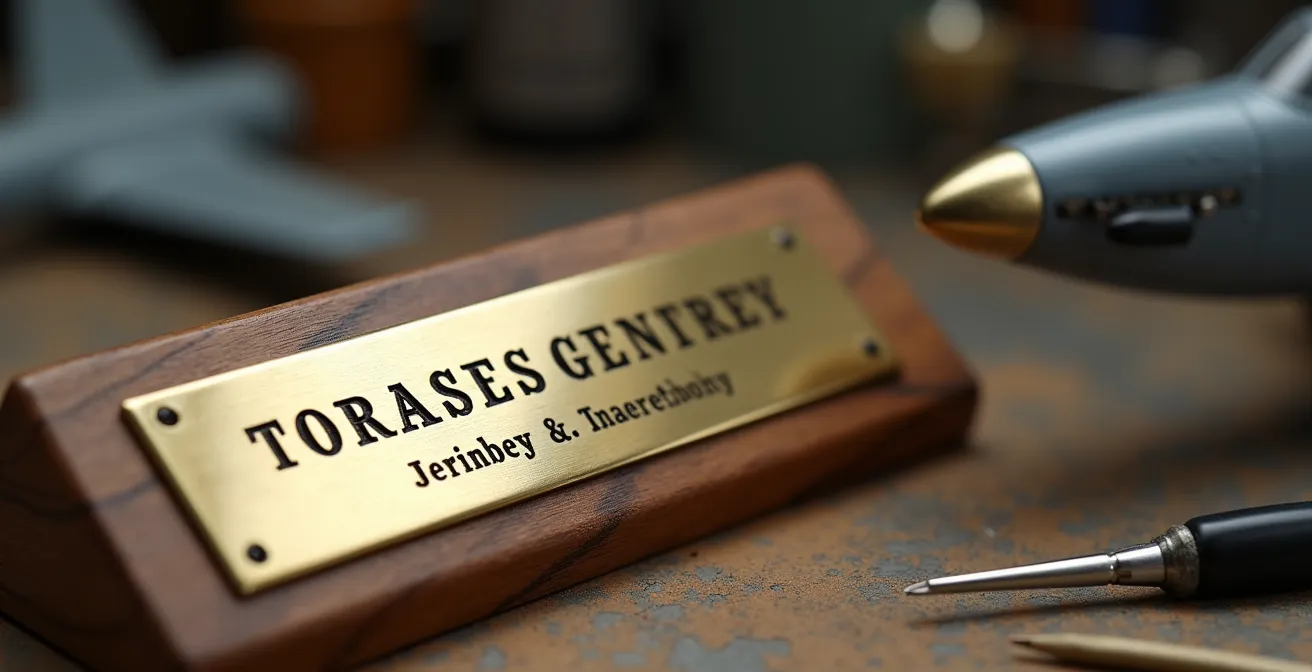
A competition nameplate is not a decorative label; it is the primary piece of evidence a judge uses to assess your research and historical accuracy before even touching the model.
- Incomplete or inaccurate nameplates are a leading cause for elimination in preliminary judging rounds.
- Every element—from the data provided to the font and material—must support the model’s specific historical context.
Recommendation: Treat the nameplate as the foundational document of your presentation. Its creation demands the same level of research and precision as the model itself.
In the world of competitive scale modeling, immense effort is channeled into achieving the perfect panel line wash, the most realistic weathering, and flawless decal application. Modelers spend countless hours ensuring their creation is a faithful miniature representation of the real subject. Yet, at the judging table, the first element that often captures a judge’s attention is not the model itself, but the small, engraved plaque that sits beside it. Many competitors treat this as an afterthought—a simple label. This is a critical error in judgment.
From a judge’s perspective, the nameplate is not a mere accessory. It is the model’s official documentation, its legal brief, and the framework through which your work will be evaluated. It provides the essential context required to assess accuracy. An entry without a proper nameplate is like an uncaptioned historical photograph; it may be technically impressive, but it lacks the vital information that gives it meaning and credibility. A well-executed nameplate signals professionalism and meticulous research, predisposing a judge to view your work with a higher degree of seriousness.
This guide moves beyond the simplistic advice of “include the name and scale.” It establishes the formal standards that judges expect for competition-level nameplates. We will dissect the mandatory data points, explore how material and mounting choices reflect on your presentation, and detail why typographic accuracy is a non-negotiable component of a high-fidelity replica. The objective is to transform your nameplate from a simple tag into a powerful, silent advocate for the quality of your work.
This article details the exact standards and unspoken rules that separate amateur presentations from professional, award-winning entries. The following sections provide a normative framework for every aspect of your nameplate’s creation and placement.
Summary: A Judge’s Guide to Engraved Nameplates for Competition Entries
- Why scale, unit, and location are mandatory data points for judges?
- Adhesive tape vs Screws: how to mount plates to wood without damage?
- Brass or Gold Plastic: which material looks premium without the cost?
- The “Messerschmitt” typo: why you must triple-check German names?
- Gothic or Sans Serif: choosing a font that matches the aircraft’s nationality?
- Military vs Civil Aircraft Models: Which Collection Retains Value Better?
- What Defines a High-Fidelity Replica for Serious Aviation Collectors?
- How to Choose an Acrylic Case That Protects Your Models from UV Yellowing?
Why Scale, Unit, and Location Are Mandatory Data Points for Judges?
The primary function of a competition nameplate is to provide contextual framing. Without this data, a judge cannot accurately assess your work. The scale, unit, and location are not trivial details; they are the fundamental parameters that define the historical reality you are attempting to replicate. A model of a P-47 Thunderbolt from the 8th Air Force in England in 1944 should look fundamentally different from one serving in the Pacific Theater. The nameplate is your declaration of which specific reality you have chosen, allowing a judge to evaluate your weathering, markings, and ordnance loadout against the correct historical backdrop.
Failure to provide this information immediately signals a lack of serious research. It forces the judge to make assumptions or, more likely, to penalize the entry for incomplete documentation. In the highly competitive preliminary rounds, this is often enough to set your model aside. Indeed, judging guidelines are clear that basic construction flaws or incomplete documentation are primary filters; an astonishing 95% of models can be eliminated in the first round for these reasons alone. Your nameplate is your first and best defense against such an early exit.
Providing this data demonstrates documentation integrity. It proves that you have not just built a generic “Spitfire,” but a specific aircraft from a specific squadron at a specific point in time. This precision is the very definition of high-fidelity modeling and is a prerequisite for earning top marks in any serious competition.
Essential Data Points Checklist for Your Nameplate:
- Scale Ratio: State the exact scale (e.g., 1/48, 1/72) as the primary identifier.
- Unit Designation: Specify the complete unit, including squadron, group, and wing (e.g., 357th Fighter Group, 363rd Fighter Squadron).
- Location & Time: Include the specific airfield, country, and time period (e.g., RAF Leiston, England, January 1945).
- Pilot/Aircraft Name (If Applicable): If the aircraft had a specific pilot or nose art, include it.
- Source Verification: Ensure all information is cross-referenced with at least two reliable historical sources before engraving.
Adhesive Tape vs Screws: How to Mount Plates to Wood Without Damage?
The method used to affix a nameplate to its base is a subtle but significant indicator of a modeler’s overall attention to detail. A beautifully finished wooden base marred by glue residue or poorly aligned screws detracts from the professionalism of the entire presentation. The choice of mounting method should be a deliberate decision based on the value of the base, the desired permanence of the display, and the need for potential reversibility.
For high-value, custom-made wooden bases, the primary concern is avoiding permanent damage. In this context, methods like museum putty or recessed neodymium magnets are the professional standard. They offer a secure hold without altering the base, allowing the nameplate to be removed or replaced without a trace. This is particularly important for models that may be updated or sold later. Conversely, high-strength adhesives like 3M VHB (Very High Bond) tape offer a permanent, clean-looking solution but risk damaging the wood’s finish if removal is attempted. They are best suited for permanent display pieces where the base and nameplate are considered a single unit.
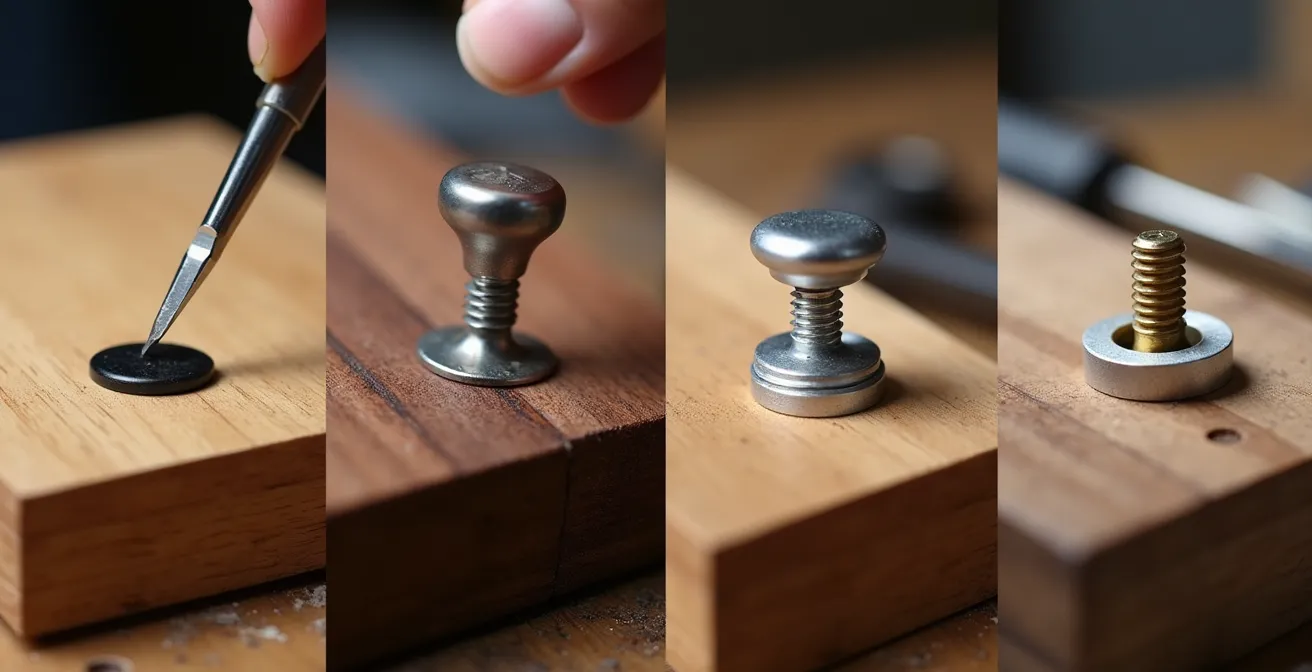
Traditional brass screws offer the strongest physical bond and can lend a classic, mechanical aesthetic. However, they create permanent holes and require precise drilling. A misaligned screw is an immediate and obvious flaw. If screws are chosen, they must be perfectly countersunk and aligned, with the slot orientation (if applicable) being consistent. The following comparison provides a clear framework for making a professional choice.
As this comparative analysis of mounting options shows, the ideal method depends entirely on the context of the presentation.
| Method | Reversibility | Hold Strength | Base Damage Risk | Best For |
|---|---|---|---|---|
| Museum Putty | 100% Reversible | Medium | None | Valuable custom bases |
| 3M VHB Tape | Difficult | Very High | Low-Medium | Permanent displays |
| Brass Screws | Reversible | Highest | Permanent holes | Replaceable bases |
| Recessed Magnets | 100% Reversible | High | None | Premium presentations |
Brass or Gold Plastic: Which Material Looks Premium Without the Cost?
The material of a nameplate carries a material subtext—a subconscious message about the subject it represents. The choice between traditional brushed brass and modern layered plastics is not merely a matter of cost, but one of aesthetic and historical harmony. A common mistake is to default to a material without considering how it complements the aircraft’s era and character. From a judge’s standpoint, the material should feel like a deliberate extension of the model’s narrative.
Traditional brushed brass is the classic standard for a reason. It evokes a sense of history, permanence, and gravitas, making it an ideal choice for subjects from the World Wars and the “golden age” of aviation. Its weight and cool touch convey quality. However, it requires maintenance to prevent tarnishing and can be more expensive to engrave. In contrast, modern layered acrylic and flexible plastics offer immense versatility. A black-surfaced plastic that engraves to a white or gold core can provide superior contrast and a clean, modern look that is perfectly suited for jet-age aircraft, spacecraft, or “what-if” subjects. The key is the quality of the finish; sharp, beveled edges and a matte surface can make a high-quality plastic look more premium than poorly finished brass.
Case Study: Material Selection at Scale ModelWorld
An analysis of award-winning models at the 2024 IPMS-UK Scale ModelWorld competition revealed a distinct trend. High-quality, laser-etched layered acrylic nameplates were overwhelmingly preferred for modern jet and sci-fi subjects, praised for their sharp edges and high-contrast text. For WWI and WWII propeller aircraft, traditional brushed brass remained dominant. The deciding factor for judges was not the raw material, but the quality of the edge finishing and the appropriateness of the material to the subject’s era.
Ultimately, a premium look is achieved through execution, not just material. Budget-friendly materials can be elevated with professional finishing. Techniques such as chemically blackening engraved letters for maximum contrast, flame-polishing acrylic edges to a glass-like clarity, or applying a matte lacquer to seal brass are all marks of a skilled presenter. As detailed in guides on professional aircraft data plate finishing, the final appearance is a matter of technique.
The “Messerschmitt” Typo: Why You Must Triple-Check German Names?
There is no faster way to undermine the credibility of a meticulously researched model than with a typographical error on its nameplate. A misspelled aircraft name, an incorrect designation, or a misplaced umlaut is a glaring red flag for any judge. It immediately suggests carelessness and casts doubt on the accuracy of the entire project. If such a simple, visible detail is wrong, what other, less obvious errors might be present in the build itself? This is the question that will instantly form in a judge’s mind.
Common errors, such as “Messerschmidt” instead of Messerschmitt, “MIG” instead of the correct acronym MiG (for Mikoyan-Gurevich), or attributing a Spitfire to “Rolls Royce” instead of Supermarine, are surprisingly frequent. These mistakes are symptoms of insufficient or single-source research. The “documentation integrity” of your entry demands a rigorous, multi-stage verification process before any engraving is commissioned. This is not optional; it is a fundamental step in professional presentation.
A formal pre-engraving protocol should be adopted. This includes reading the text backward to catch spelling errors, cross-referencing all proper nouns and technical terms with at least three independent, authoritative sources (such as manufacturer archives, official museum records, or academic publications), and having a fellow modeler proofread the final text. For subjects using non-English alphabets or diacritics, like German umlauts (ü, ö, ä) or the Eszett (ss), this verification is even more critical. These are not decorative marks; they are integral parts of the word and its pronunciation.
The following table, based on information from sources like the Academy of Model Aeronautics, highlights common pitfalls that must be avoided.
| Nation | Common Error | Correct Form | Verification Source |
|---|---|---|---|
| Germany | Messerschmidt | Messerschmitt | Luftwaffe archives |
| Russia | MIG | MiG (Mikoyan-Gurevich) | Soviet records |
| UK | Rolls Royce Spitfire | Supermarine Spitfire | RAF Museum |
| Japan | Zero Fighter | Mitsubishi A6M | IJNAF records |
Gothic or Sans Serif: Choosing a Font That Matches the Aircraft’s Nationality?
Typography is an often-overlooked dimension of historical accuracy. The font on a nameplate should not be chosen based on personal preference or what “looks cool.” It must be selected with the same historical rigor as the model’s paint scheme. This principle is called typographic harmony: the style of the text should be consistent with the nationality, era, and character of the aircraft. Using an Art Deco font like Broadway for a modern F-22 Raptor is as historically jarring as putting the wrong national insignia on its wings.
For German WWII subjects, for example, a clean, technical sans-serif font like DIN 1451 is far more appropriate than a generic Times New Roman. DIN was a standard industrial typeface in Germany during that period and reflects the engineering-focused ethos of the era. For modern USAF aircraft, a stencil-style font such as Amarillo USAF accurately mimics the lettering applied to real aircraft and their equipment. For glamorous 1930s racing planes, an elegant Art Deco typeface reinforces the period aesthetic. The font is part of the story.
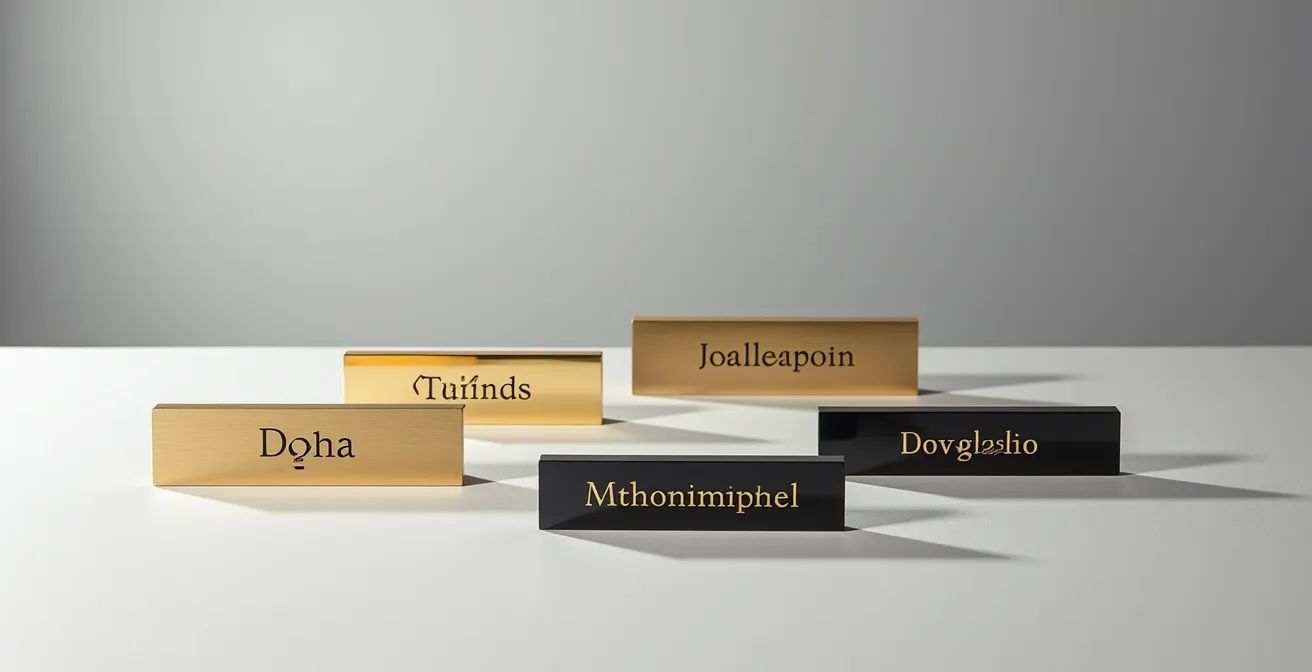
A judge with subject matter expertise will recognize and appreciate this level of detail. It demonstrates a holistic approach to research that extends beyond the physical aircraft to its entire cultural and technical context. The font choice, engraving depth, and even the letter spacing all contribute to the overall authenticity of the presentation. It transforms the nameplate from a simple information carrier into a piece of graphic design that supports the replica’s narrative. When done correctly, the nameplate and model appear to belong together, as if they were produced by the same historical forces.
Military vs Civil Aircraft Models: Which Collection Retains Value Better?
While the primary motivation for most modelers is passion, the question of a collection’s long-term financial value is a valid consideration. Whether military or civil aircraft models retain value better is a complex debate, but one factor is consistently decisive: the quality and completeness of the documentation. A nameplate is the most visible component of this documentation. It elevates a model from a well-built kit to a documented historical replica, which has a direct and measurable impact on its perceived and actual worth.
Military models, particularly of famous aircraft or those associated with specific aces, often have a broad collector base. Their value is tied to historical significance, and a nameplate that precisely identifies the aircraft, pilot, unit, and theater of operations is crucial. It provides the provenance that collectors demand. Without it, a beautifully built model is just another anonymous representation.
Civil aircraft models, on the other hand, often derive their value from rarity and livery accuracy. For these models, the nameplate must capture different but equally critical data.
Case Study: The Value of Civil Registration Numbers
Analysis of high-value civil aircraft model sales, referenced by specialty engravers, shows that specific registration numbers are paramount. A model of a Concorde with a generic British Airways livery is of moderate interest. However, a model documented by its nameplate as G-BOAC, the flagship of the Concorde fleet, commands a significant premium. The nameplate should include the specific registration, the airline, the service route, and key dates. Models with generic liveries and no specific documentation consistently sell for 50-60% less than their fully documented counterparts.
Ultimately, the subject matter is secondary to the execution and documentation. A well-documented civil aircraft model will always be more valuable than a poorly documented military one, and vice-versa. The nameplate is the lynchpin of this documentation, directly influencing a collection’s ability to retain, or even appreciate, in value.
What Defines a High-Fidelity Replica for Serious Aviation Collectors?
For a serious collector or a top-tier competition judge, a “good model” is not enough. The goal is a high-fidelity replica, a term that implies a level of accuracy and documentation far beyond the norm. A high-fidelity replica is not merely a representation; it is an academic argument in three-dimensional form. It posits that a specific aircraft looked a specific way on a specific day, and it provides the evidence to support that claim. The nameplate is the title page and abstract of this academic work.
The definition of fidelity has evolved. It is no longer sufficient to simply list the aircraft type and squadron. The new standard, driven by the expectations of collectors and the highest echelons of competition, demands a deeper level of documentation directly on or with the presentation. This includes the aircraft’s specific serial number or Bureau Number, the production block, and even the exact mission or sortie date that justifies the ordnance and weathering patterns shown on the model.
Furthermore, a truly high-fidelity presentation acknowledges the construction process itself. Listing the base kit and any significant aftermarket parts or scratch-built modifications used demonstrates transparency and confidence in one’s work. The most advanced presentations are now including QR codes on their nameplates, linking to a digital build log, research bibliography, and referenced historical photographs. This is the pinnacle of documentation integrity.
Case Study: The Smithsonian’s Museum-Quality Standard
The standard for museum-quality presentation offers a clear benchmark. According to practices outlined by firms that produce museum-grade data plates, the Smithsonian National Air and Space Museum’s model collection requires nameplates to include builder information, scale, date of construction, and a concise history of the specific aircraft depicted. For example, their F4U-1 Corsair model is not just any “Corsair.” Its nameplate explicitly locks it to VMF-214’s “Pappy’s Plane” as it appeared on December 23, 1943, over Rabaul. This level of specificity justifies every scratch, fluid stain, and configuration detail on the model, transforming it into a historical document.
Key Takeaways
- A nameplate’s primary role in competition is to provide the contextual documentation required for accurate judging.
- Meticulous accuracy in all data points (scale, unit, name, date) is a non-negotiable prerequisite for serious consideration.
- Material and font choices are not merely aesthetic; they must be historically and nationally consistent with the aircraft’s era to achieve true fidelity.
How to Choose an Acrylic Case That Protects Your Models from UV Yellowing?
The final step in any serious modeling project is preservation. A display case is not just a dust cover; it is an archival solution designed to protect your investment of time and skill. The primary enemy of a finished model—after physical damage—is ultraviolet (UV) light, which causes paints to fade and clear parts to yellow over time. Choosing the right acrylic case is therefore a critical decision, and one that has implications for the nameplate as well.
When selecting a case, the single most important feature is UV protection. Standard acrylic offers little to no defense against UV radiation. You must specify museum-grade or archival acrylic, which is treated to block over 98% of UV rays. While more expensive, it is the only way to ensure the long-term stability of your model’s finish. This is a professional standard, not a luxury.
Once the case is chosen, the placement of the nameplate becomes a new strategic consideration. Placing it inside the case on the model’s base offers the most integrated look, but makes maintenance or changes difficult. Placing it on the exterior of the case’s front panel or base makes it highly visible and easy to change, but can look less integrated. A premium option is to have the information laser-etched directly onto the acrylic case itself, creating a seamless and permanent presentation. A flexible alternative is a removable magnetic plate that attaches to the outside of the case. Each option has its merits, depending on the intended permanence and budget.
A final challenge with cased displays is glare. A glossy nameplate inside a glossy case can be difficult to read under direct lighting. To mitigate this, one must consider anti-glare solutions. Opt for matte-finish plastics over glossy ones, use chemical blackening to create high-contrast text, and consider positioning the nameplate at a slight angle to deflect reflections. Using museum-quality non-reflective acrylic for the case itself is the ultimate solution, though it comes at a premium.
To ensure your next entry receives the consideration it deserves, you must begin by treating its nameplate not as an afterthought, but as the foundational document of its presentation. This commitment to documentation is the ultimate mark of a professional modeler.